Take a look at this picture.
What do you notice? Did you know that by making observations, asking questions and making inferences about this picture, you are actually doing what a good reader does with text?
These three skills are important for readers to use. Good readers think carefully about what they are reading, and use what they know to "read into" what they are reading. We have been working on an activity we call, "Picture of the Day" to help us become better readers. Want to join us? Here's what we do:
1. Make observations.
Observations are what you see with your eyes. They are things you notice. Here are some examples of observations we made abut this picture:
- there is a boat
- the man is wearing shorts and is barefoot
- the sky is clear
- his leg is bent and his hands are in the air
- he is smiling
Notice we couldn't say, "He is jumping into the water." We don't know that by seeing it with our eyes. But we can INFER that's what he is doing from what we see.
2. Ask questions.
Here are some of our questions:
- why are his hands up?
- is it hot?
- is he at a lake?
- is that his boat?
Finally, we use what we noticed and asked to make inferences.
3. Make inferences
- We infer that it is hot because he is wearing shorts, has no shirt on and is barefoot.
- We infer that he is jumping into the water because his leg is bent and he is stepping off the boat.
- We infer he is not at the ocean because the water is calm and there are trees in the background.
Good readers do the same things when they read. They notice what the author is saying, ask questions to themselves and draw conclusions and make inferences based on that information. Soon this activity will become part of our reading rotations each morning.
The next time you are reading with your child - or see a great photo somewhere! - try making inferences. You may be surprised to find out what your child is thinking!
Monday, February 9, 2015
Saturday, January 24, 2015
My Pet Whale - Or Not?
These last two weeks have been busy in our classroom! We spent time last week reading a story called Dear Mr. Blueberry, all about a little girl who is convinced she has a whale in her pond. Her teacher, Mr. Blueberry, is convinced that there could not possibly be a whale there. They communicate through letters, each expressing their own opinion.
Not only did we do some whale research, but we also started thinking.... would a whale make a good pet? We brainstormed the characteristics of a good pet
and then shared our own reason why a whale would or wouldn't make a good pet.
Then we wrote an opinion piece, using an opening sentence, reasons with details and a closing sentence.
What do you think - would a whale make a good pet?
Saturday, January 10, 2015
"Snow" Much Fun in the New Year!
Happy New Year! 2015 has arrived and we are back at school ready to take on everything that winter has to offer.
This week, we used the book Snow, by Cynthia Rylant, to review figurative language and talk about the tone of a text. Then we compared that book to another snow-themed book, called Snow Dance.
While both books we about snow, they had very different tones and word choices. Snow was more calm and peaceful, filled with figurative language and imagery that made for great visualizations! Snow Dance on the other hand, was a book with rhyming lines than bounced along and made you smile and want to go out and play in the snow!
We continued the theme of snow during book groups. Snowflake Bentley and Poppleton in Winter were the choices here.
We also read one of our Scholastic News magazines to find out how this amazing ice-covered lighthouse was formed. Be sure to ask your child about it - amazing!
We kept the snow going with some math and our Snow People glyphs. The parts of each glyph tell about the person who created it. For example, you can tell by looking at the nose if the best part of a snow day is having no school (round) or playing in the snow (triangular). Here are some of our finished snowy friends!
We then "read" the information from the glyphs and analyzed the data.
The snow this week definitely helped to add to our topic! Let's hope next week gives us a full five day to be able to start our adventure to the North and South poles.... I wonder what we'll find?
Sunday, December 7, 2014
Put a little kindness in your life....
Have you heard about this little guy?
He (or one of his friends) has been making a daily appearance in our classroom. The elf hides somewhere (so far not good enough to stay hidden!) each day and brings a kindness challenge for use. Last week saw challenges such as "Say hello to 4 adults in the hallway" and "Smile at 10 people." (Friday's was "Do a chore at home without being asked." - did it happen? :-)
We've been getting really good at meeting the challenges. The goal of the Kindness Elf is to spread good cheer and just general "niceness" in our classroom and beyond. It is important for kids to know that being nice can take many forms - and can be contagious!
If you notice your child doing or saying something nice in these next few weeks, point it out! Those positive words can go a long way towards keeping the kindness going!
Saturday, November 15, 2014
Put a little hamburger into your writing
Ask your child and they'll be able to tell you!
Writing an organized piece is a lot like putting together a hamburger. The bun holds everything together and the "fix-ins" are the details. We put this idea to work the past few weeks working on both narrative and expository (informational) writing.
Not only did we work on the basic structure, we also talked about how important it is to make each part the best it can be - juice, delicious and filled with either feelings, actions, dialogue (narrative writing) or important details and added information (informational writing).
And what better way to help us remember the parts of the hamburger as we work, but with a little help from SpongeBob!
That's right, Krabby Patties to the rescue! As students worked independently on their own paragraphs about bats, they each had a Krabby Patty nearby to keep them focused on each part.
As they wrote each part, they got to eat that part of the Patty!
Our paragraphs came out great and we definitely know how to "think hamburger" when writing!
Coming up next week, we'll begin applying this idea to opinion writing.. stay tuned!
For my teacher friends - This idea comes from the wonderful Hope King at Elementary Shenanigans. Click HERE to see more about it.
Saturday, October 25, 2014
Spiders, spiders, spiders
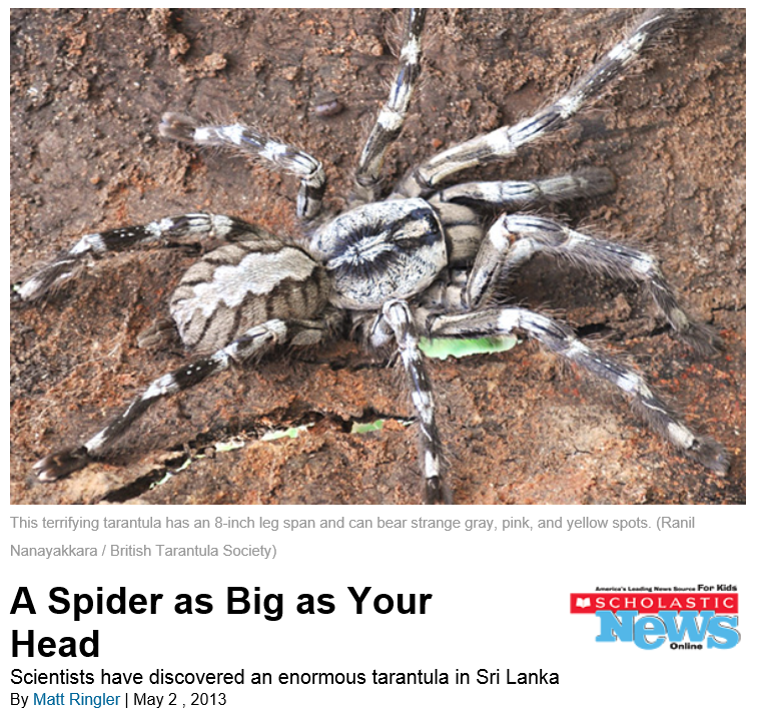
Have you seen our spider board? We spent the week researching spiders and created a fact board complete with nonfiction text features to showcase our work. We worked on creating illustrations and captions, a table of contents, an index and a glossary. When you read a nonfiction book with your child, talk about any of these features - and how they help the reader locate information.
Here's a great article about a GIANT spider! We read the article in class and answered 5W questions (who, what, when, where, why - and how!) about the text. Click on the image to read the article for yourself.
Nonfiction books are a fun way to introduce your child to different genres. Kids of all ages love finding facts about things they enjoy. Have you read any great nonfiction books lately?
Saturday, October 4, 2014
Addition Strategies
It's hard to believe it's October already! We spent this week reading fiction stories with a fall theme and focusing on the setting. We also finished up our math unit on addition strategies.
It is important for second graders to know their math facts (addition and subtraction to and from 20) quickly - without having to count. We talk about being able to "see it and say it" when doing math facts. We also worked on many different strategies to help us "use what we know" when figuring out math facts. Here is a picture of the anchor chart we created that hangs in our room.
This chart acts a reference for quickly solving math facts. When practicing math facts with your child, see if they can tell you a quick strategy to use to find the answer - instead of counting on all the time. The faster your child can master these facts, the easier math will be when we introduce new concepts and skills.
Looking for more practice? Here are 3 fun sites to visit to make learning facts more fun! Click on the image to head to the game.
Have fun!
Subscribe to:
Posts (Atom)